Bloques de rodamientos libres de corrosión para tornillos de plomoBloques de cojinetes de sinteración láser dryspin®
Para los tamaños de rosca de 6 a 24 mm, se encuentran disponibles prácticos bloques de soporte de tornillo de plomo. Opciones para el montaje con cojinetes lisos o rodamientos de bolas (BB) con mayor dinámica. Todos los bloques de soporte del tornillo de plomo, como los anillos de sujeción del tornillo de plomo correspondientes, se suministran en aluminio anodizado duro.
► Libre de
lubricación y sin mantenimiento ► Carcasa para soporte de husillo de plomo
► Orificios de montaje para su diseño
► Preparados para la conexión de accesorios como indicadores de posición y abrazaderas manuales
► Bloques de rodamientos de sinterizado láser disponibles para tornillos de plomo de 6mm de diámetro
► Versiones para rosca TR y DS
FL: rodamientos fijos con anillo de sujeción anodizado con rosca derecha y cojinetes lisos iglidur® libres de lubricación
LL: rodamientos flotantes con anillo de sujeción anodizado con rosca derecha y cojinetes lisos iglidur® libres de lubricación LL: rodamientos flotantes con anillo de sujeción anodizado con rosca derecha y cojinetes lisos iglidur® libres de lubricación LL: rodamientos flotantes con anillo de sujeción anodizado con rosca derecha y cojinetes lisos iglidur® libres de lubricación LL: rodamientos flotantes rodamientos
LH: roscas
__
Why are there different versions?
The bearing arrangement has to fulfil the principle of clarity. Furthermore, the bearing must ensure the defined control of the force flow. If it does, the bearing is considered statically determined. There are various bearing options, such as the
fixed floating bearing and the
double-sided floating bearing.
Fixed floating bearing:the fixed bearing clearly positions the shaft in an axial direction. The fixed bearing must therefore absorb both radial and axial forces and guide them into the surrounding structure. This can basically be fulfilled by a single bearing. The floating bearing corrects parallelism errors minimally and offers thermal expansion capability, which means that the cable is not stressed.
Advantages of fixed floating bearing
► No axial clearance
► Non-critical shaft expansion (due to such factors as temperature)
► Suitable for changing axial loads
► Clarity of forces applied
Double-sided floating bearing:in a double-sided floating bearing, the lead screw is not clearly fixed in the axial direction. This means that without stressing the bearing, mechanical or thermal differences in length can be absorbed, but the lead screw is not protected against drifting. This has to be considered in particular when dealing with positioning applications.
Advantages of double-sided floating bearings:
► Cost-effective
► Low design cost
► Non-critical shaft expansion (due to such factors such factors as temperature) in the area of clearance
Disadvantages:
► Not clearly fixed in the axial direction
► Not suited to changing axial loads
► Only if axial clearance does not impair function
____
Versions
Fixed bearing version (FL)Depending on thread dimensions, this version has the clamping ring clamped into the lead screw itself or to the lead screw's outer diameter. For high helix lead screws, it is always the outer diameter that it is clamped to.
► Note:
you can also choose a bearing block for your application that uses the measurement d1 for clamping onto the turned machined end.
Floating bearing (FL):depending on the lead screw's dimensions, a machined end must be turned to the value d1. You can see below which dimensions this applies to. The floating bearing block merely supports the lead screw. This type does not prevent the lead screw from drifting.
Ball bearing type (BB):this bearing block should always be used in case of highly dynamic applications, e.g. when a motor is involved
__
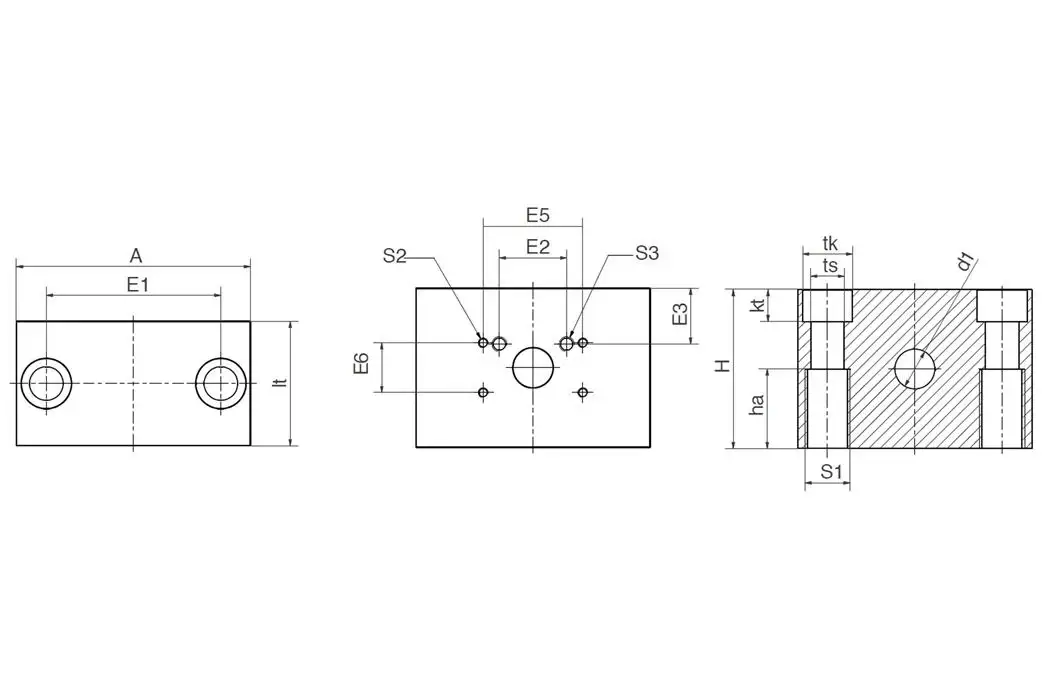
opcionales de la izquierda, solo TR10, TR2, TR10 y TR3 _____________________________________________________________________________________________________________________________________________________________________________________________________________________ _______________________________________________________________________________________________________ Punta de diseño para el mecanizado de extremos del tornillo de plomo: | Número de parte | d1 mm | | | | | | | | | | | | | | |
| SLS-16-LL | 12 |
| SLS-16-LL | 12 |
| SLS-18-LL | 12 |
| SLS-18-LL | 12 |
| SLS-18-LL | 12 |
| SLS-18-LL | 12 |
| SLS-20-LL | 12 |
| SLS-24-LL | 14 |
| SLS-S16-LL | 12 |
| SLS-S18LL | 12 |
| SLS-S20-LL | 12 |
► Nota sobre la capacidad máxima de carga: puede exceder la carga máxima de la tuerca del tornillo de plomo.

.png)