Cambiar idioma :
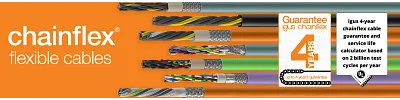
Cables flexibles para aplicaciones de movimiento industrial
Soluciones de cables chainflex® confiables y de larga duración para movimiento continuo
Respaldados por una garantía de vida útil de 4 años verificada por UL, estos cables se prueban rigurosamente para ofrecer confiabilidad, durabilidad y rendimiento inigualables. Con más de 1,394 tipos de cables disponibles, chainflex® ofrece una gama completa para datos, bus, híbridos, control, motor, servo, retroalimentación, coaxial, fibra óptica (FOC), robótica y aplicaciones especiales. Diseñados para soportar condiciones extremas, los cables chainflex® están diseñados para resistir la exposición al aceite, temperaturas extremas y varios tipos de movimiento, incluyendo horizontal, torsional y alto- movimientos de velocidad.
Buscar cables chainflex®


Buscar cables adicionales


Historias de aplicaciones de chainflex®


Navegar por la caja de herramientas del ingeniero
Preguntas frecuentes sobre los cables flexibles continuos
Los cables
chainflex® son cables de movimiento flexible continuo de grado industrial diseñados para aplicaciones dinámicas como robótica, automatización y maquinaria. Se prueban durante millones de ciclos y se diseñan para evitar fallas de cables en entornos exigentes.
Los cables estándar a menudo fallan bajo movimiento constante, lo que lleva a tiempos de inactividad y costosos reemplazos. Los cables flexibles continuos chainflex® están diseñados con materiales especiales y trenzado optimizado para soportar hasta 2 mil millones de ciclos de prueba, lo que garantiza una larga vida útil y una transmisión de señal confiable.
igus® ofrece una gama completa de cables de movimiento flexible continuo que incluye cables de torsión de control, datos, servo, motor, bus, híbridos, de fibra óptica, coaxiales, robóticos y soluciones readycable® preensambladas.
Los cables chainflex® vienen con una garantía verificada por UL de hasta 4 años de vida útil. Esta garantía se basa en pruebas en el laboratorio de pruebas de cables más grande del mundo de su tipo, donde los cables se someten a hasta 2 mil millones de ciclos anuales.
Los cables flexibles continuos chainflex® cumplen con los estándares globales que incluyen UL, CE, EAC, NFPA 79 y sala limpia ISO Clase 1. También soportan los principales protocolos de comunicación como PROFINET, PROFIBUS, EtherCAT
y CC-Link.
Mediante el uso de diseños especializados para flexión continua, los cables chainflex® minimizan las grietas de aislamiento, roturas de conductores y problemas de EMI. Esto significa menos fallas en los cables, menos downtime de la máquina y mayor eficiencia de producción.
igus® ofrece cables robotizados diseñados específicamente para el movimiento torsional 3D con hasta ±360° de rotación por metro, lo que los hace ideales para robots multieje y maquinaria automatizada.
El sistema Chainflex CASE reduce el desperdicio de empaque, mejora el manejo de cables, reduce los costos de envío hasta en un 84% y permite un repedido fácil, lo que permite un ahorro de costos y una logística más ecológica.
Sí. Dependiendo del tipo de cable, están disponibles con materiales resistentes al aceite, estables a los rayos UV, retardantes de llama y libres de halógenos,
lo que los hace adecuados para entornos industriales hostiles.
igus® proporciona herramientas en línea gratuitas que incluyen una calculadora de vida útil y un configurador de cables. Estos le ayudan a seleccionar el cable adecuado y predecir su performance en su aplicación específica.
Sí. Los ingenieros y gerentes de compras pueden solicitar una caja de muestra de cable gratuita para evaluar el rendimiento del producto antes de comprometerse con pedidos más grandes.
Los cables híbridos combinan líneas de alimentación servo y retroalimentación en un solo cable flexible continuo, lo que reduce el espacio, simplifica el enrutamiento y reduce los costos de instalación, perfecto para los sistemas modernos de servounidades.
Sí. Con el servicio igus® readycable®, los cables flexibles continuos se pueden pedir preensamblados con conectores de marcas como Siemens, Beckhoff, Allen Bradley y SEW, listos para la instalación plug-and-play
.
igus® ofrece más de 1,394 tipos de cables flexibles continuos, disponibles sin una cantidad mínima de pedido. Puede ordenar por pie (o metros), y la mayoría envía dentro de las 24 horas.
Contacto
¿Preguntas o información sobre productos? Por favor, póngase en contacto con:

igus® México.+52 728 2843185Correo
Servicio al cliente
Servicio al Cliente:
Teléfono: De lunes a viernes, de 8:00 a 20:00
Chat en vivo: 24 horas